
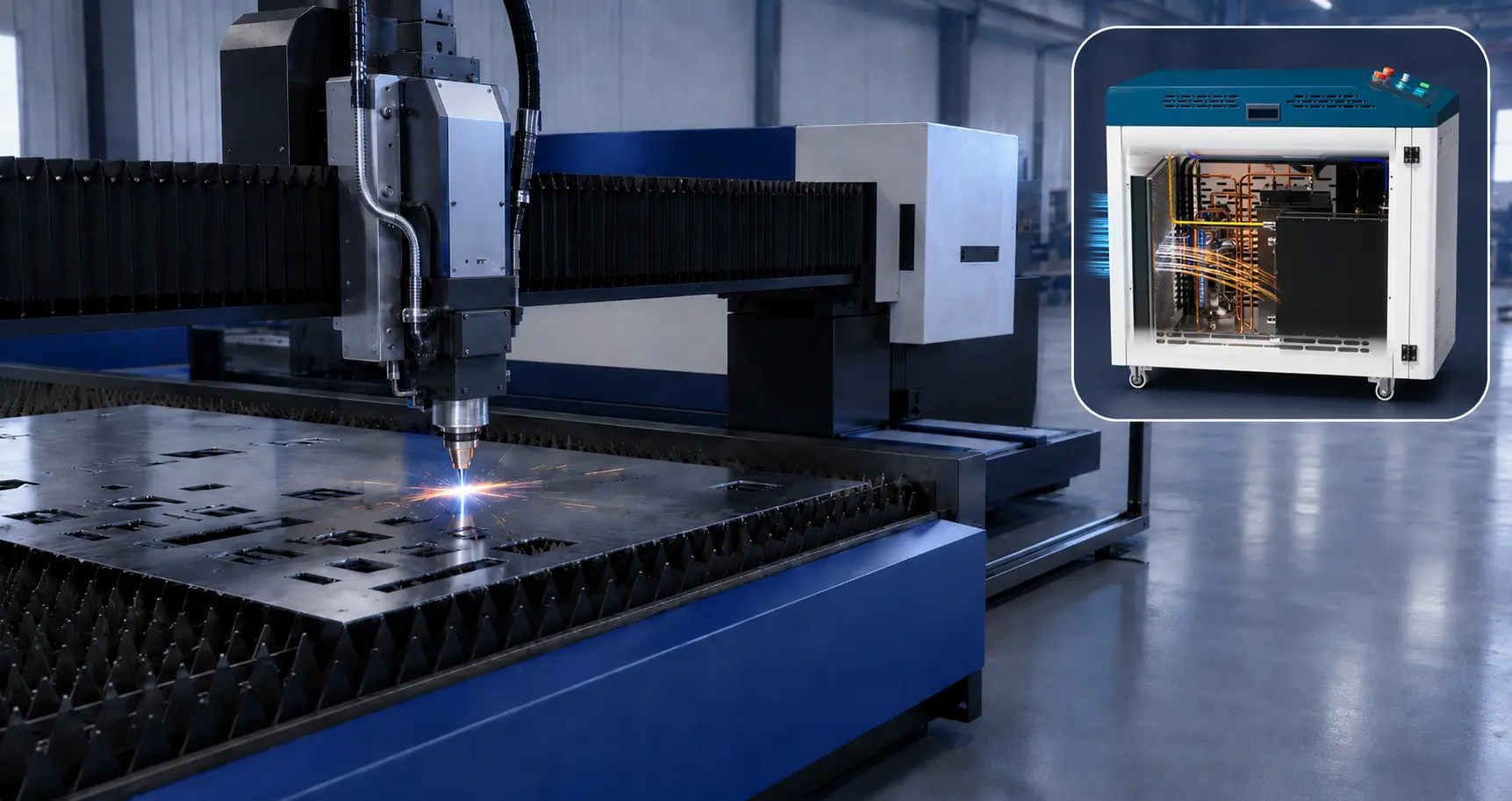
Cooling System in Fiber Laser Cutting Machines: Complete Guide
In fiber laser cutting machines, users often focus on laser power, cutting speed, or automation level. However, in real production environments, one of the most critical systems that directly determines stability, cutting quality, and machine lifespan is the cooling system.
A fiber laser machine may look powerful from the outside, but without a stable thermal management system, even the most advanced laser source cannot maintain consistent output. Many cutting issues that appear to be “laser problems” are actually caused by temperature instability.
This guide provides a deeper engineering-level understanding of how fiber laser cooling systems work, how to select the right system, common failures, maintenance practices, and real-world production insights.
I. Why Cooling System Is Critical in Fiber Laser Cutting Machines
A fiber laser cutting machine coverts electrical energy into laser energy, but a significant portion of energy still becomes hear during operation. This heat is generated in multiple key areas:
- Fiber laser source
- Optical transmission system
- Cutting head and lens assembly
- Electrical control components
Without proper cooling, hear accumulates quickly and leads to thermal instability.
What happens when temperature is unstable?
From real factory experience, users may observe:
- Cutting edges become rough or inconsistent
- Burr information increases on carbon steel
- Stainless steel edges turn yellow or oxidized
- Hole precision becomes unstable
- Laser power fluctuates during long operation
These issues are often misdiagnosed as “laser quality problems,” but in reality they are caused by thermal drift in the optical and electronic system.
II. How the Cooling System Works in a Fiber Laser Cutting Machines
Most industrial fiber laser machines use a closed-loop water cooling system (industrial chiller system).
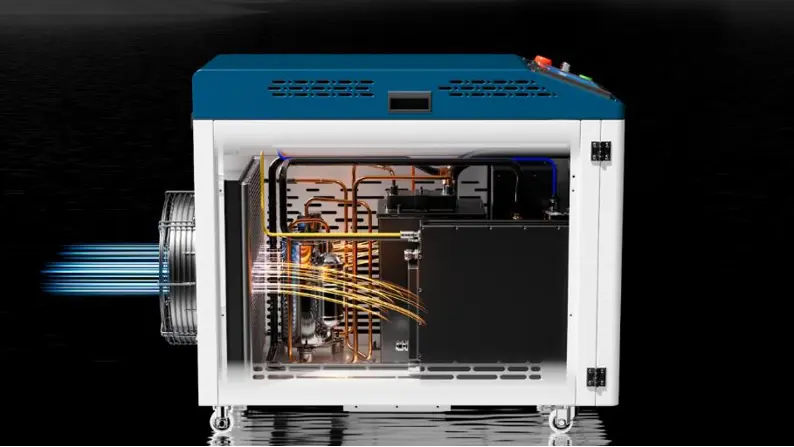
The cooling process includes four continuous stages:
1. Heat Absorption
Cooling water circulates through:
- Laser source module
- Fiber transmission components
- Cutting head and optics
It absorbs heat generated during laser operation.
2. Heat Return
The heated water flows back to the chiller unit through a sealed pipeline system.
3. Refrigeration Process
Inside the chiller:
- Refrigerant is compressed
- Heat is released through condenser
- Expansion valve reduces pressure
- Evaporation process absorbs heat
- Water temperature is reduced to preset level
4. Continuous Circulation
Cooled water is continuously pumped back into the system, forming a stable closed loop.
In industrial fiber laser machines, temperature stability is often more critical than cooling capacity alone. A stable cooling system helps maintain consistent laser output, reduce thermal drift, and improve cutting quality.
Typical temperature control accuracy ranges include:
- ±0.3°C for high-precision industrial chillers
- ±0.5°C for standard laser cooling systems
Even small fluctuations can affect beam stability.
III. Types of Cooling Systems in Fiber Laser Cutting Machines
Fiber laser cutting machines generally use two main types of cooling systems depending on power level and application requirements.
1. Water Cooling System (Industrial Chiller)
Water cooling systems are the standard solution for medium and high-power fiber laser machines.
They use an industrial chiller to circulate temperature-controlled water through the laser system.
Key Advantages:
- High cooling efficiency for continuous operation
- Precise temperature control (±0.3°C or better)
- Suitable for high-power laser machines
- Stable performance under long production cycles
- Supports 24/7 industrial manufacturing
Typical Applications:
- Sheet metal fabrication
- Automotive components
- Heavy machinery parts
- Industrial mass production
2. Air Cooling System
Air cooling systems rely on fans and heat sinks to dissipate heat.
Common Applications:
- Laser marking machines
- Low-power engraving machines
- Small-format light-duty cutting equipment
Advantages:
- Simple structure, no water required
- Lower maintenance cost
- Easy installation
- Limited cooling capacity
Limitations:
Air cooling systems are not suitable for high-power cutting applications because:
- Limited cooling capacity
- Poor temperature stability under load
- Not suitable for continuous cutting
- Risk of overheating during long operation
3. Water Cooling vs Air Cooling: Which One Is Better?
| Application Type | Recommended Cooling System |
| High-power metal cutting | Water cooling |
| Continuous industrial production | Water cooling |
| Light marking/engraving | Air cooling |
| Intermittent small batch processing | Air cooling |
In modern industrial environments, water cooling dominates over 90% of fiber laser cutting applications due to stability requirements.
IV. Real Production Experience: What Operators Actually Notice
In real factory environments, cooling system performance becomes very noticeable during long production cycles.
Stable cooling condition:
- Consistent cutting quality throughout the day
- Stable laser output
- Minimal alarms or interruptions
- Reliable batch production
Early warning signs of cooling degradation:
- Cutting quality varies between shifts
- Slight increase in burr or oxidation
- Occasional temperature warnings
- Reduced piercing performance
Severe cooling failure symptoms:
- Laser protection alarms
- Automatic machine shutdown
- Optical component overheating risk
- Significant cutting instability
V. Key Components of a Fiber Laser Cooling System
A complete industrial cooling system includes:
Industrial Water Chiller
Core unit responsible for heat removal and temperature control.
Dual-Circuit Cooling Design
High-power machines often separate cooling loops:
- Laser source cooling loop
- Cutting head and optics loop
This improves stability and reduces thermal interference.
Flow and Pressure Monitoring System
Continuously monitors:
- Water flow rate
- Pressure stability
- Blockages or abnormal circulation
Water Quality Control System
Uses:
- Deionized or purified water
- Anti-corrosion protection
- Anti-scale treatment
to protect internal optical and cooling components.
VI. Cooling System Sizing and Selection Guidelines
Choosing the correct cooling system is critical for long-term stability.
Key Selection Factors:
1. Laser Power Level
- 1–3kW → Standard chiller
- 6–12kW → Dual-loop chiller recommended
- 20kW+ → High-capacity industrial chiller required
2. Ambient Temperature
High ambient temperature increases cooling load significantly.
Workshop environments above 35°C require oversized cooling capacity.
3. Duty Cycle
- Intermittent cutting → standard configuration
- Continuous 24/7 production → industrial-grade redundant cooling system
4. Material Type
- Stainless steel → higher thermal load
- Carbon steel → moderate load
- Aluminum → reflective heat sensitivity considerations
VII. Common Cooling System Problems and Troubleshooting
1. Overtemperature Alarm
Possible causes:
- Low coolant level
- Dirty condenser
- High ambient temperature
- Pump degradation
2. Flow Rate Warning
Possible causes:
- Pipe blockage
- Filter contamination
- Air trapped in system
3. Temperature Instability
Possible causes:
- Faulty thermostat
- Poor chiller calibration
- Water quality issues
4. Laser Power Fluctuation
Often indirectly caused by:
- Cooling instability
- Optical thermal drift
VIII. Maintenance Best Practices
To ensure long-term stability:
- Replace deionized water regularly
- Clean condenser fins every 1–2 months
- Check filters and pipelines
- Maintain stable workshop temperature
- Avoid dust accumulation around chiller
- Inspect refrigerant pressure annually
Proper maintenance can extend laser source lifespan by 30–50%.
IX. Why Temperature Stability Matters More Than Cooling Capacity
Many users assume “bigger chiller = better performance,” but this is not accurate.
In fiber laser systems, even small temperature fluctuations can cause:
- Beam quality variation
- Wavelength drift
- Focus shift
- Inconsistent kerf width
In precision manufacturing, even ±1°C variation can impact final part quality and assembly accuracy.
Conclusion: Cooling System Is the True Stability Core of Fiber Laser Machines
In fiber laser cutting machines, performance is not only determined by laser power or mechanical structure, but by how effectively thermal energy is controlled during continuous operation.
A stable cooling system provides:
- Consistent cutting quality
- Longer laser source lifespan
- Reduced maintenance frequency
- Higher production uptime
- Improved overall ROI
Ultimately, the cooling system is not a supporting accessory—it is a core stability subsystem of modern laser manufacturing.
FAQ
1. Can a fiber laser work without a chiller?
No. High-power fiber laser machines require active cooling. Without it, damage to the laser source can occur within minutes.
2. What is the ideal temperature range for a water chiller?
The typical temperature control range of industrial water chillers is 5°C–35°C. Users can set the target temperature based on the cooling requirements of different laser systems and industrial equipment to ensure stable operation.
3. How often should cooling water be changed?
Typically every 3–6 months depending on water quality and usage intensity.